
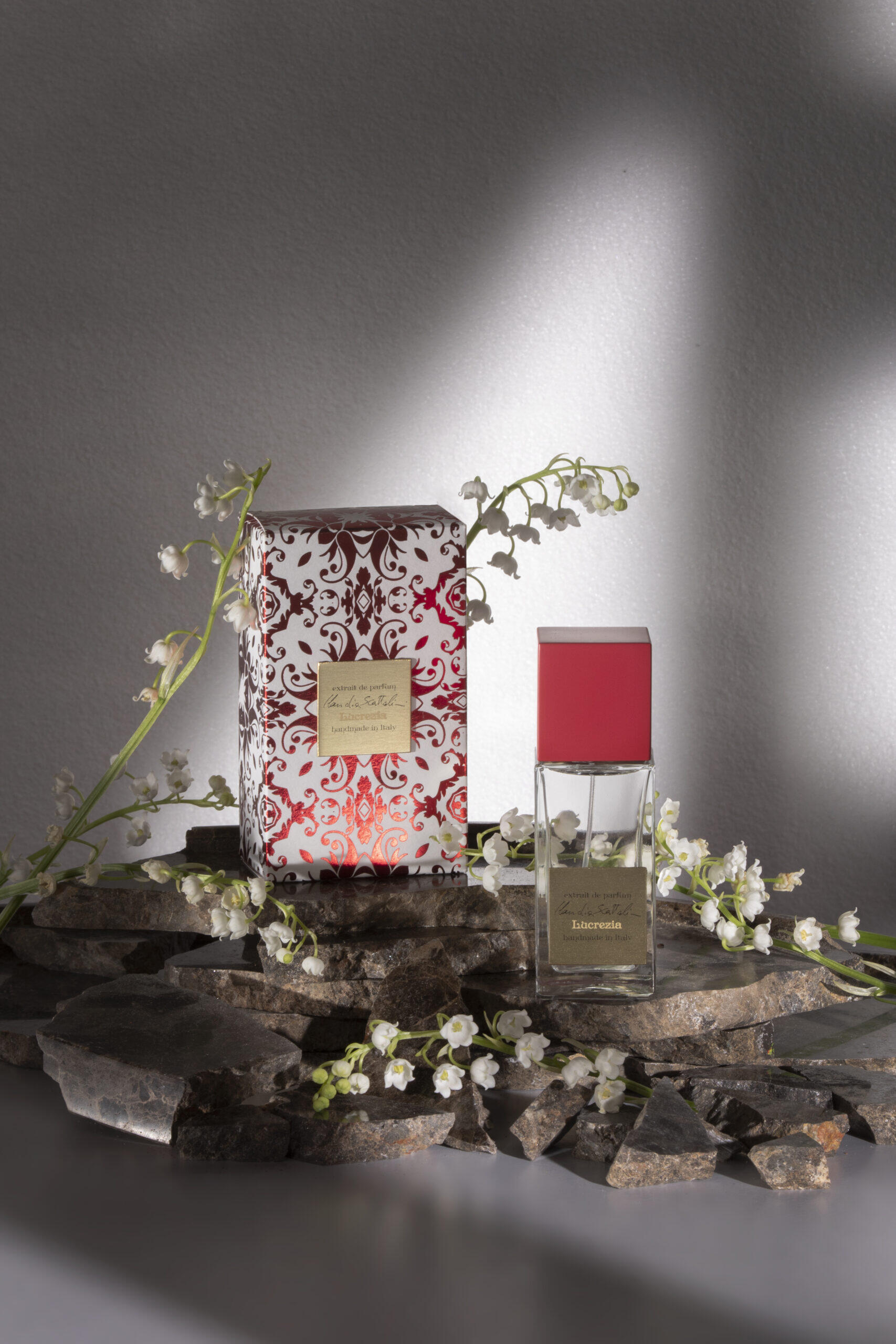
di Claudia Scattolini
The olfactory chemistry of my Lucrezia Extrait de Parfum
What am I really smelling when I breathe in a perfume?
In perfumery, there is often a gap—sometimes subtle, sometimes vast—between what we see in the beautiful olfactory pyramids on books and websites, and what actually makes up the formula of a fragrance. Marketing narratives tend to simplify with evocative words, but behind a “sea breeze,” a “rose note,” or a “breath of lily of the valley,” lies a far more intricate construction: that of molecular accords.

An olfactory accord is not the direct sum of the ingredients listed on a label. It is a proper creation, that can evoke a flower even when that flower, like lily of the valley, cannot be extracted, or when a raw material was of animal origin and is now banned, or for other technical or ethical reasons. What we perceive as a “natural note” is often the result of a precise, sophisticated combination of both natural and human-made molecules.
When I speak of olfactory chemistry, I’m not talking about artifice. I’m speaking of authenticity rebuilt, of science placed at the service of emotion. This is the true heart of artistic perfumery: not a copy of nature, but a creative act that reinterprets, elevates and makes it both accessible and enduring.
Olfactory chemistry is a vital tool and expertise in perfumery. It allows us to interpret and shape the most complex essences, breaking fragrances down into their most intimate elements—the aromatic molecules—and then recomposing them with meticulous precision.
This scientific approach is the foundation of modern artistic perfumery. It is the key to creativity that pushes beyond the boundaries of what nature alone can distill. Chemistry, in this sense, does not limit nature—it magnifies its most fleeting, intangible nuances.
For this reason, starting this month, I will be publishing a monthly article on my blog entirely dedicated to olfactory chemistry. My aim is to make it accessible and engaging, showing what really happens when a perfume is created. Because at its core, perfumery is a matter of chemistry.
Lily of the valley in perfumery: a “silent flower”.
But why can’t its natural scent be extracted?

Lily of the valley, the symbolic flower of May, embodies a quiet purity and resilience that has always fascinated me. Its fresh, crystalline scent hides a paradox: it is a “silent flower.” Despite its iconic fragrance, its essence cannot be directly extracted through traditional techniques—the essential oils are simply too delicate to capture. Its fragrance exists only thanks to meticulous recreation through sophisticated molecular accords.
In Lucrezia Extrait de Parfum, this very peculiarity became my deepest inspiration. I wanted to restore this “impossible” flower in all its authenticity.
The lily-of-the-valley accord in Lucrezia is a continuous molecular construction which—like the woman who inspired it, Elena Lucrezia Cornaro Piscopia, the first woman in the world to earn a degree in 1678—does not need to raise its voice to leave an indelible mark. Its uniqueness is inherent and enduring.
How is the lily-of-the-valley fragrance created in perfumery? The molecular accord.
How do you give a voice to a flower that cannot be distilled? The answer lies in the olfactory chemistry of true perfumers.
The lily-of-the-valley scent is one of the most instantly recognizable: a white flower that remains pure, transparent, and luminous, without the sensual facets that often characterize other white florals.
To create the lily-of-the-valley bouquet in Lucrezia Extrait de Parfum, several key molecules are combined with absolute precision:
- Bourgeonal. The starting point of the accord. With its leafy-green nuances and metallic-aqueous floral touch, it brings lift and verticality to the composition. Its subtle pheromonal aspect, also studied by Prof. Foresta at the University of Padua, adds yet another layer of complexity.
- Hydroxycitronellal. Historically associated with lily of the valley, it provides transparent, green, and lightly pure nuances, creating a clean floral-aquatic trail. Alongside Bourgeonal, it forms the backbone of the accord.
- Cyclamen Aldehyde. A molecule that adds brilliance and almost ozonic freshness, amplifying the luminosity of the lily-of-the-valley accord. It lends a modern, airy character with a floral-fruity nuance reminiscent of orange blossom.
- Linalyl Acetate, Terpineol, and Citronellol. These compounds round out the harmony with floral, citrusy, and slightly herbal touches, echoing the complex spectrum of shades found in the natural flower.
The lily-of-the-valley accord in Lucrezia is not a single note but a molecular bouquet—a carefully modulated olfactory symphony.
A perfumer may emphasize different facets to create a personal interpretation of lily of the valley, but the goal remains the same: to capture its most authentic, radiant essence.
The Lily of the Valley in Lucrezia Extrait de Parfum: meaning and olfactory pyramid.
In Lucrezia Extrait de Parfum, the lily of the valley reveals itself as an architecture beating at the floral heart of the fragrance, lending brightness and an intellectual sensuality.
This soliflore dedicated to lily of the valley ensures that the entire olfactory bouquet revolves around this magical flower: silent, yet powerfully present from the very first spray—before allowing other notes such as rose, jasmine, orange blossom, tarragon, and geranium leaf to emerge in perfect harmony.
Lily of the valley is a heart note that, in Lucrezia, becomes a symbol of intelligence and purity—just like Lucrezia Cornaro Piscopia herself, to whom this perfume is dedicated, whose brilliance needed no adornment.
It is a clear, precise presence—not decorative but structural. It is the fragrance’s “white soul”, an inner light that manifests immediately.
Olfactory pyramid of Lucrezia Extrait de Parfum:
- Top: Bergamot, Lemon
- Heart: Lily of the Valley Accord, Rose, Jasmine, Orange Blossom, Tarragon, Geranium Leaf
- Base: Vanilla, Ambergris, Leather, Vetiver, Precious Woods
The lily-of-the-valley accord supports the floral heart of the fragrance like the pillar of a Renaissance building.
It is the voice you perceive at once and that lingers, like an echo in memory. Creating this accord required a balance of discipline, expertise, and deep inspiration—carefully weighing the ethereal with the tangible, the romantic with the cerebral.
The result is a perfume that does not impose itself, but rather settles into the heart—like a noble thought, a word whispered at the right moment, or a melody that reaches the soul when it is most needed.