
A NEW STRUCTURE AND PERCEPTION IN CONTEMPORARY PERFUMERY
di Claudia Scattolini
Contemporary perfumery is evolving and with it the tools used to describe fragrances. The traditional olfactory pyramid is gradually giving way to new interpretations that better reflect the complexity of today’s scents.
As in any creative or scientific field, the world of fragrance is shaped by social, cultural and technological contexts. Even well-established models are re-evaluated and reinterpreted in light of these changes. One such model is the olfactory pyramid.
I have always dedicated myself to identifying every transformation within the fragrance world: analyzing it, studying it, and adapting it to modern times.
The olfactory pyramid: the historical foundation of fragrance composition.
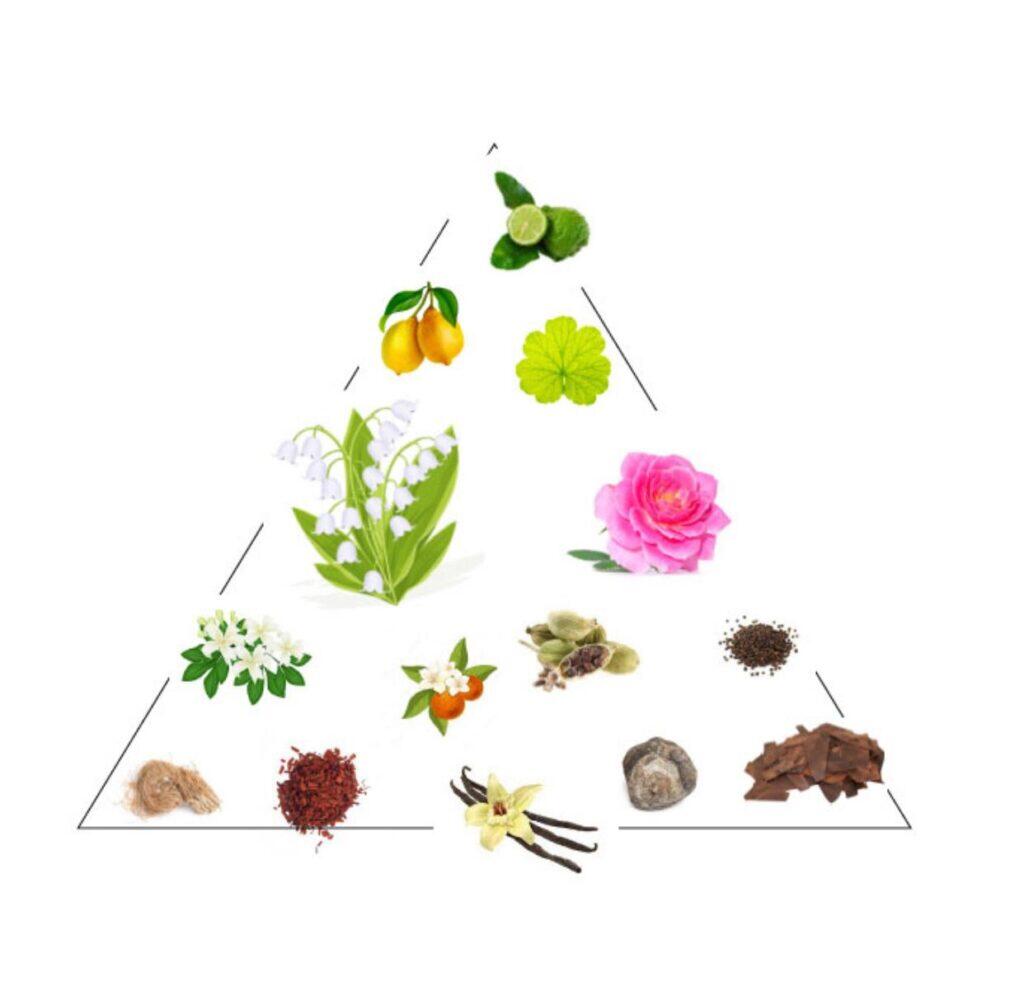
In 1947, French perfumer Jean Carles (1892–1966) introduced a descriptive structure for fragrance that would deeply influence the entire 20th century: the olfactory pyramid.
“Carles, creator of iconic scents for Carven, Dana and Ma Griffe, was also a visionary educator. His pyramidal model—comprising top, heart, and base notes—became the universal reference for explaining the temporal evolution of a fragrance. It was the clearest and most immediate method for understanding how a scent developed on the skin.”
This is how I studied it too, in 2001, during my training at ISIPCA, the renowned perfumery school founded by Guerlain in Versailles. At that time, it was foundational, the essential grammar for reading and constructing a fragrance. The pyramid taught us order, proportion and timing; it was the structural basis upon which we learned to compose.
But today, the landscape has changed.
The evolution of perfumery: the olfactory pyramid no longer captures new forms of expression.
In contemporary perfumery, the olfactory pyramid is beginning to appear too rigid to accommodate the expressive freedom and complexity that today’s perfumers pursue.
With the advent of extraordinary synthetic molecules, the structure of a fragrance is no longer determined solely by the evaporative order of natural materials.
Molecules such as Iso E Super, Ambroxan, Cashmeran, and Timbersilk, alongside new encapsulation and fixation technologies, have transformed the compositional principles.
We can now perceive woody or ambery notes right from the top or maintain citrus freshness all the way to the drydown, overturning every prediction based on the traditional model.
New fragrances redefine the rules of composition.
More and more fragrances in recent years have chosen to move away from the pyramid model, presenting themselves in a more immediate, pure, and conceptual way.
Escentric Molecules 01, for instance, marked a turning point: a fragrance centered almost entirely around a single molecule — Iso E Super — that does not follow a classic developmental narrative. It’s a scent that pulses, appears and vanishes on the skin like a shadow or an echo.
In a different way, Santal 33 by Le Labo offers a linear, coherent experience: the creamy sandalwood is perceivable from the beginning, accompanied by a near-constant aura that lingers for hours without developing in traditional layers.
Then there’s Gypsy Water by Byredo, where fresh and balsamic notes coexist with sweeter, warmer ones from the very beginning, blending together in a circular structure—more akin to a sensation than to a temporal sequence.
These fragrances do not unfold sequentially but exist in their entirety from the first encounter.
New olfactory languages: linear, spherical, personal signatures and emotion.
Today, many contemporary perfumers describe fragrances as linear or spherical, where notes coexist simultaneously rather than follow a chronological order.
The pyramid’s hierarchy gives way to a more fluid, organic and personal vision.
“A fragrance today doesn’t necessarily need to tell a story with a beginning, middle and end. It can be a single moment suspended in time.” Dominique Ropion
“I’m no longer interested in building a pyramid. I prefer to work with the overall impression, like a painter with a brushstroke.” Christine Nagel (Hermès)
This shift also reflects in how fragrances are communicated: many niche (and not only niche) brands have stopped using “notes” in the traditional sense, opting instead for imagery, synesthetic experiences, and abstract sensations.
I find this new approach to communication expanded and unrestricted by imposed boundaries.
A notable example is Maison Crivelli, which describes its perfumes using expressions like: “a matcha tea sipped during an electric storm” or “a vetiver in the heart of a sandstorm.”
The olfactory pyramid should be a teaching tool, not a creative constraint.
The olfactory pyramid remains a valuable didactic tool, useful in perfumery schools and for guiding beginners through the world of scent composition. It also helps to explain a fragrance to the general public in an accessible way.
However, for those who create with depth and for those with a curious, open-minded nose, the pyramid is becoming increasingly confining.
Forcing a modern composition into a classical structure risks oversimplifying it, dulling its expressive potential and diminishing its true value.
It’s like describing a contemporary vision using outdated thought categories—its most authentic meaning is lost, and innovation is not done justice.
Today, we are free to create non-narrative perfumes that don’t need to open and close like a story but exist as a constant energy, a scent signature, a gesture.
We are free to experience a fragrance more intuitively, emotionally and personally—free to no longer “wait for the bottom” to detect woody accords, or to believe that freshness belongs only at the beginning.
Perfumery is no longer a sequence to follow note by note. It is a magnetic field, a vibration in the air, a living cloud that breathes with the skin.
And perhaps in this new expressive freedom lies a more authentic dimension of perfumery—one that resonates more deeply with who we are today.
It’s time to look beyond the pyramid, not to deny its importance, but to explore new perspectives.
New olfactory paradigms: the Iso E Super molecule.
To better understand how the new directions in perfumery manifest in practice, we must focus on certain molecules that have helped redefine compositional principles.
Among them, one stands out for its ability to challenge the traditional logic of the olfactory pyramid: Iso E Super.
Key molecule: Iso E Super and its influence.
Discovered by IFF in the 1970s, Iso E Super has become a symbol of contemporary perfumery.
With its woody, velvety, and enveloping facets, enriched by a hint of clean skin and mineral tones, it is known for its elusive effect: perceived in waves, it seems to vanish and then return.
It’s a molecule that has transformed how we compose fragrances: low in volatility but perceivable from the first moment, it defies the classic pyramid logic and the educational notion of a “bottom note.”
It is the soul of Escentric Molecules 01, but is also found (often unlisted) in dozens of modern fragrances due to its ability to create airy, woody transparency without weight.
My mentor Jean-Claude Ellena used it masterfully in Terre d’Hermès, where it generates that signature mineral warmth—both airy and grounded. That’s where I grasped its potential.
Following his example, I chose to use this molecule in my Wood\&Skin extrait de parfum, to create a quiet sensuality that pulses on the skin more than it radiates into the air.
Iso E Super challenges the traditional olfactory pyramid: with low volatility yet immediate detectability, it allows for the creation of linear and spherical compositions—where notes coexist simultaneously rather than sequentially.
Iso E Super is an expression, an atmosphere, a deep rhythm—one of the keys to a new perfumery freed from hierarchy.
It is the perfect example of how a single molecule can deconstruct the pyramid’s structure and open new olfactory dimensions.